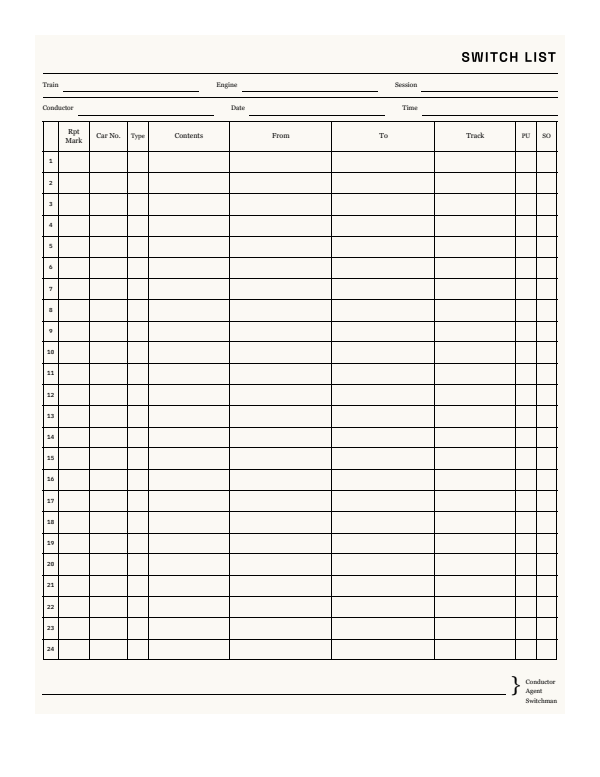
Modern
Clean ruled form
A crisp, plain form that photocopies well and is easy to read in the aisle.
Download PDF Torus Train Ops
Free Printable Model Railroad Operations Forms
Printable PDFs for your next operating session: switch lists in three styles, car cards, waybills with empty car bills, and four-cycle waybills.
Free to download, print and copy. No signup, no email. Every sheet is US Letter, and the cards have crop marks for a paper cutter.
PDF files. Print at Actual size or 100%.
These are the forms Torus Train Ops prints, left blank for you to fill in by hand. Each one has 24 numbered lines for the car, its type, contents, where it comes from and where it goes, with pick up and set out columns.
Clean ruled form
A crisp, plain form that photocopies well and is easy to read in the aisle.
Download PDF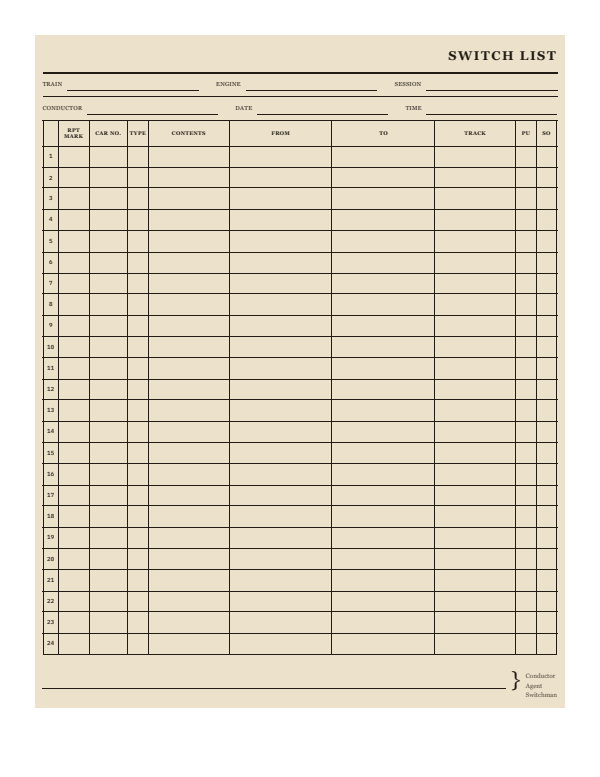
1940s–1960s railroad form
Laid out like the typed and ruled forms railroads used in the steam and early diesel years, on tan stock.
Download PDF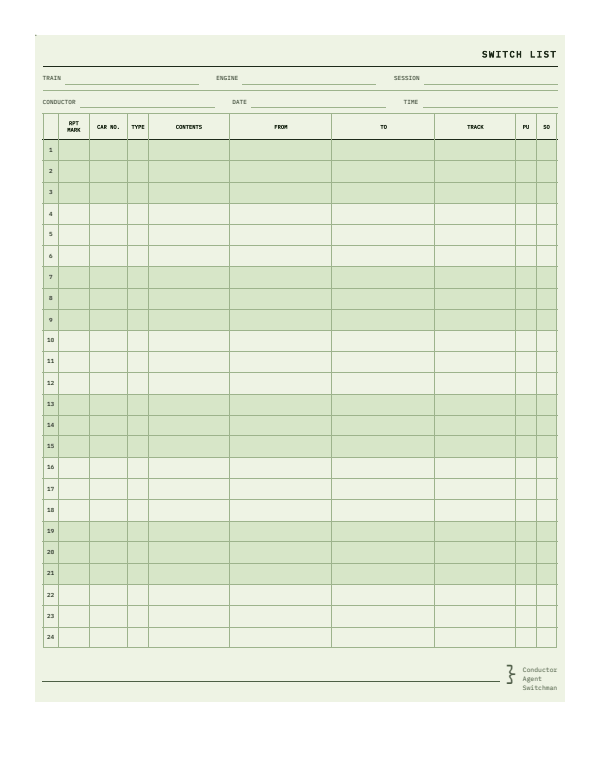
1970s–1990s green-bar
The green-bar computer paper that came off the yard office printer, banded for easy reading across the line.
Download PDFThe waybills are sized to ride in the car card pocket, with the destination showing at the top.
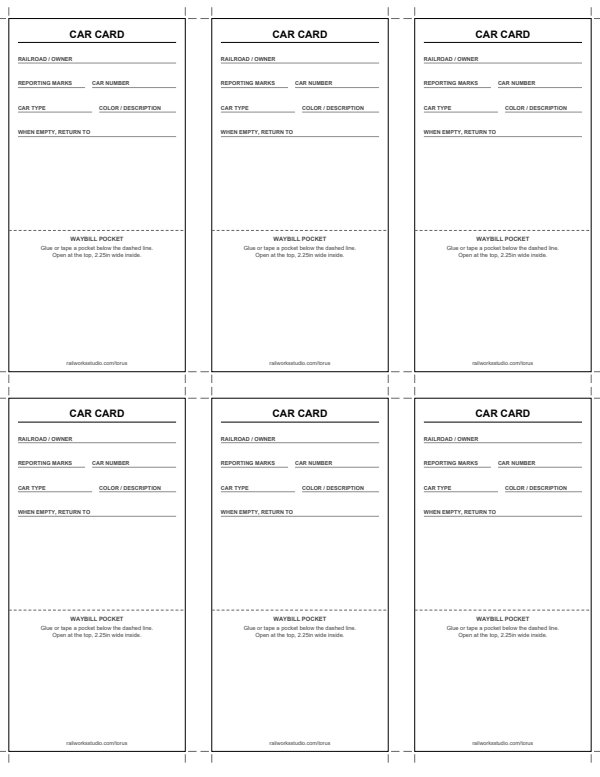
6 per sheet · 2.5 × 5 in
One card per car: owner, reporting marks and number, car type, color and where it goes when empty. The lower half is marked for the waybill pocket.
Download PDF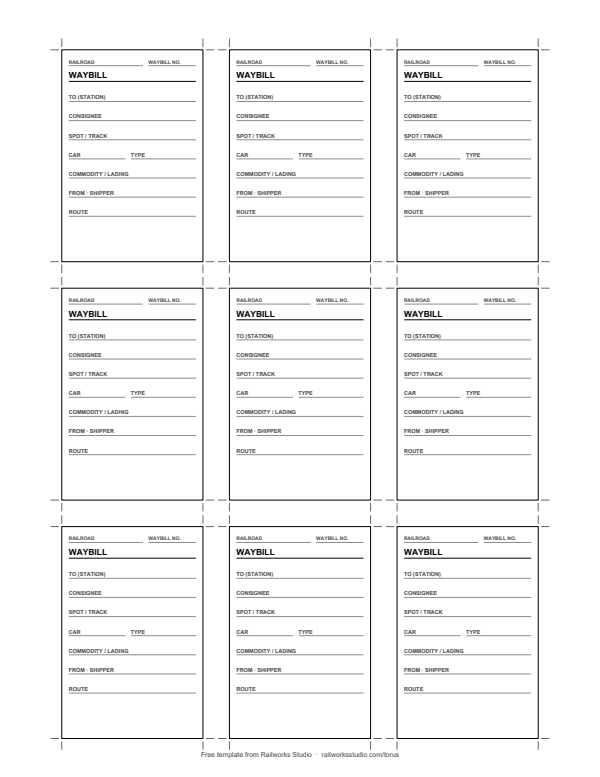
9 per sheet · 2 × 3 in · 2 pages
Page one is waybills: where the load is going, who receives it, the commodity and who shipped it. Page two is empty car bills, for sending cars home again.
Download PDF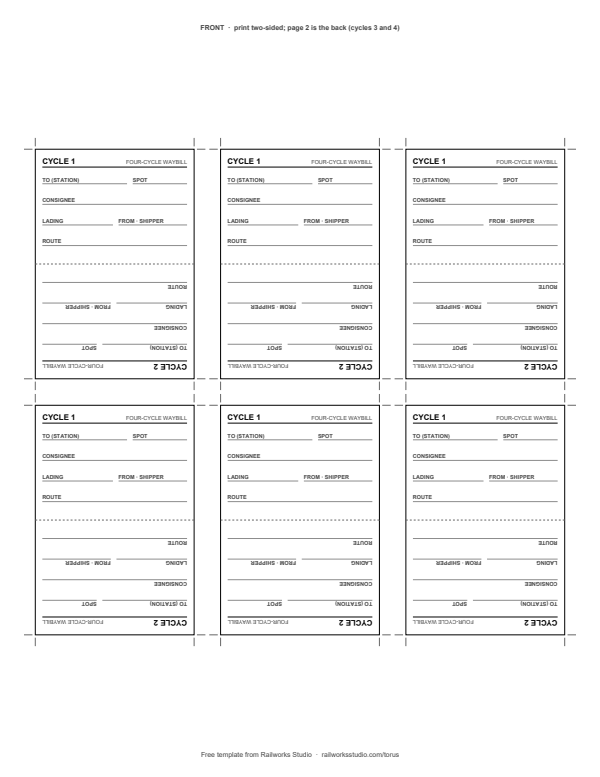
6 per sheet · 2.25 × 3.25 in · two-sided
Four trips on one bill. Cycles 1 and 2 print on the front and cycles 3 and 4 on the back, so a car keeps moving for four sessions before you write a new bill.
Download PDFMost model railroad operating sessions run on one of two kinds of paperwork, and plenty of railroads use both.
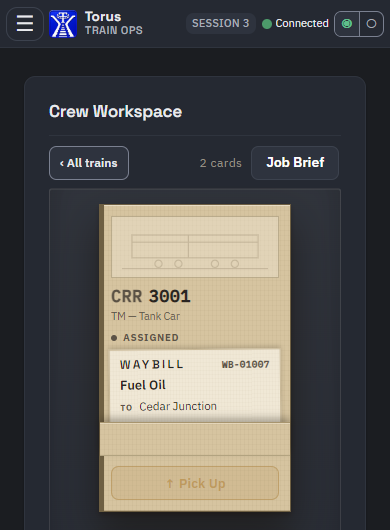
Every car on the railroad gets a car card that stays with it. When the car has somewhere to go, a waybill goes in the card’s pocket, showing the station, the industry receiving it and what it carries. The crew sorts the cards for their train, does the work, and leaves each card at the car’s new location. When the trip is done, the waybill comes out, or an empty car bill sends the car home.
A four-cycle waybill holds four trips. Only the cycle at the top shows above the pocket. Between sessions, turn the bill end for end to bring up the next cycle, then flip it over for cycles 3 and 4. One bill keeps a car moving for four sessions.
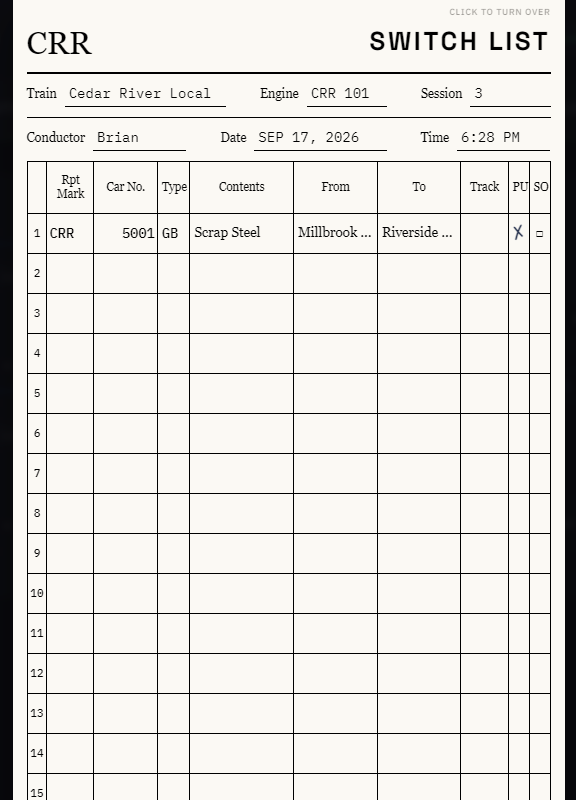
A switch list puts a train’s whole job on one sheet, in the order the work is done: which cars to pick up, where each one goes, and whether it is loaded or empty. It is quick to read in the aisle and easy to check off as you go.
Filling in waybills and switch lists for every car, every session, is the part of operations most of us would rather skip.
Torus Train Ops does it for you. You set up your industries and what they ship and receive; Torus creates the car orders, assigns cars to trains, and prints a switch list and a full set of waybills for each job, already filled in.
The switch lists on this page are Torus’s own forms, and its printed waybills are the same 2 × 3 inch card as the template here, so they drop into the same car card pockets. Crews who prefer a screen can work from their phones instead.
Yes. Download, print and copy them as often as you like for your own railroad and your operating crew. There is no signup and no email required.
Car cards are 2.5 by 5 inches, six to a sheet. Waybills and empty car bills are 2 by 3 inches, nine to a sheet. Four-cycle waybills are 2.25 by 3.25 inches, six to a sheet. All of them fit a car card pocket 2.25 inches wide.
Plain paper works for switch lists. Car cards and waybills hold up better on 65 to 110 lb cardstock. Print at Actual size or 100%, not Fit to page, so the cards come out at their stated size.
Each bill carries four trips. Only the cycle at the top shows above the car card pocket. Turn the bill end for end to show the next cycle, then flip it over for cycles 3 and 4, so one bill keeps a car moving for four sessions.
Either works. A switch list puts a train’s whole job on one sheet. Car cards and waybills travel with each car, which makes it easy to hand a job from one crew to the next. Many railroads use both.
Yes. Torus Train Ops creates the car orders from your industries and prints switch lists and waybills for each train, already filled in. Its printed waybills are the same 2 by 3 inch size as the template here.
Torus Train Ops turns your industries’ shipping and receiving into car orders, switch lists and waybills, ready for every session.
Try the complete program free for 30 days. No subscription. No ongoing fees.
Try Torus Free for 30 Days